Senin, 24 Juni 2013
Sabtu, 15 Desember 2012
17. Hortatory Exposition
Definition :
Hortatory exposition is a type of
spoken or written text that is intended to persuade the listeners or readers
that something should or should not happen or be done.
Hortatory is similar to analytical
exposition but if we have to differentiate both from one to each
other, we have one useful tool by making analysis on the generic structure.
What makes hortatory different from analytical exposition is the last
finalizing step which analytical exposition is ended by a reiteration while
hortatory is finalized by certain a recommendation.
Social Function :
To persuade the reader or listener
that something should or should not be the case
Language Feature of Hortatory Exposition Text :
1)
Focusing
on the writer
2)
Using
action verb
3)
Using
modal adverb; certainly, surely, etc
4)
Using
temporal connective; firstly, secondly, however, therefore, etc)
5)
Using
evaluative words; important, valuable, trustworthy, etc
6)
Using
passive voice
7)
Using
simple present tense
8)
The
use of modals and adverbs (e.g. may, must, should, etc)
9)
The
use of emotive words (e.g. worried, alarmed etc)
10) The use of words that qualify statements
(e.g. usual, probably etc)
11) The use of subjective opinions using
pronouns I and we
Generic Structure of Hortatory Exposition Text :
1)
Thesis : Statement or announcement of issue
concern
2)
Arguments : Reasons for concern that will lead
to recommendation
3)
Recommendation : Statement of what should or should
not happen or be done based on the given arguments
Example of Hortatory
Exposition Text
Mobile Phones Should Not be Banned in
School [Tittle]
Mobile phones is not used just for
calling, but sending text, taking pictures, accessing internet, and much more.
Many students bring their phones to school. For them, mobile phone has many
uses. So, mobile phones should not be banned in school. Why do I said
that? [Thesis]
Firstly,
students call their parents for other needs. By mobile phone, student can call
or their close relative if they need something to be brought to school. In
addition, mobile phone can be used to call their children when one of their
family were hit by disasters suddenly. And then, student can called their
parent to pick her up when want to go home. [Arguments]
Secondly,
increased of knowledge among students. When trying to find answer of difficult
task at school, mobile phone can be used as a connecting to search the answer
through GPRS or WiFi networks. [Arguments]
Finally,
expand the network of friendship among students. School is the right place to
find friend. Average, student been at school about 7 hours or more. So that, a lot
of students found their friend in the school environment . Therefore,
communication between friends should be kept on of which using a mobile phone. [Arguments]
So,
I think mobile phone should not be banned in school. But, use your phone in the
time and right place so that no one was disturbed. [Recommendation]
16. Weather Report/ Tables/ Grapsh

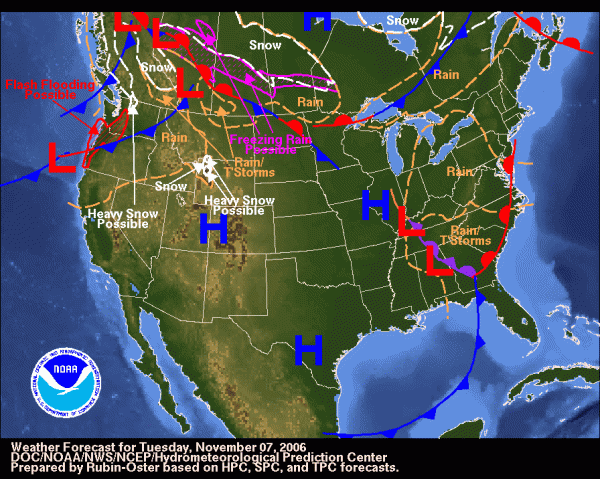
Weather report:
The text is a weather report or weatherforecast in spoken form. A weather report is a prediction of weather.
The weather is predicted through application of the principles of physics and meteorology.
Weather report usuallu find in : television , radio , newspapers and BMG office.
A
weather report is a bit technical as compared to other report writing
you have been practicing earlier. You need to choose words and phrases
correctly and present the information gathered in the language of
meteorologists.
Expressions used in a weather report :
• A high of twenty degrees.
• A low of -25.
• 20 percent chance of snow.
• Mainly sunny.
• Sunny with cloudy periods.
• Above/below average temperatures.
• A few flurries.
• 5-day forecast.
• Temperatures are going to drop/dip/plunge (go down quickly).
• Temperatures are going to rise/soar/climb (go up quickly).
• A warm/cold front is moving in (air from another region is arriving)
Name of Weather :
• Sunny
• Warm
• Hot
• Mild
• Cold
• Freezing
• Cloudy
• Foggy
• Smoggy
• Rainy
• Wet
• Dry
• Windy
• Snow
• Thunder
• Mist
• Blizzard
• Fog
• Hurricane
• Overcast
Example Weather report Text :
Hello
, Good morning. This is erick with local weather report. It will be
foggy this morning in almost all parts of town , followed by slight
showers. Homever , the showers willnot last for a long time. By early
afternoon it will be cloudy until late afternoon , followed by heavy
rain with thunder storm in the evening into the night. Thank you.
Table :
Table presents facts and figures
in compact form. There are several things that we need to pay attention
to. They are, the table title, row or column labels, information given
in individual cells and information given within rows and columns.
Steps we need to do to read the table:
1. Observing the table title
2. Observe the columns in the table
3. Found significant differences in the data, either the highest, lowest and average
4. Draw conclusions from the data presented in the table
Example:
NAME
|
CLASS
|
SCORE
|
JENNIE
|
A
|
70
|
THOMAS
|
B
|
80
|
RICK
|
B
|
75
|
JASON
|
C
|
90
|
JESSICA
|
D
|
85
|
JUSTIN
|
B
|
60
|
Graph is a visual concise means of presenting information.
There are basic kinds of graphs :
1. Bar Graphs
2. Line Graphs
3. Circle or Pie Graphs
Graphs usually find in : clinic , BPS office , Library .etc
1. Bar Graphs
Bar graphs is a type of graphs which
contains labeled horizontal or vertical bars showing a piece of
information and an axis. The numbers along the side of bar graph compose
the axis. This is also called as a histogram, bar graph is useful when there is a numerical comparison.
2. Line Graphs
A
line graph is a way of representing two pieces of information, which is
usually related and vary with respect to each other. This is useful
when comparisons are needed.
3. Pie Graphs
Cirle
graphs (sometimes called pie or circle chart) are used to show the
parts that make up a whole. They can be useful for comparing the size of
relative parts.
EXAMPLE:
Pie Graphs
Bar Graphs
Line Graphs
15. So, Too, Either, Neither , Etc
1. “So and “too”. The
words ‘so; and ‘too’ are used combine two positive statements with
identical predicates to form a compound sentence. An auxiliary must be
included in the second part of the sentence.
However, there is a difference while using ‘so and ‘too’.
-so + auxiliary verb + subject
-subject + auxiliary verb + too
Subject 1 + to be/verb+ object/complement+and+so+aux+subject 2
Example:
Snow White was beautiful
The Queen was beautiful
(Snow White was beautiful and so was The Queen)
Examples:
I likes playing guitar. Fandy also likes playing guitar.
- I likes playing guitar and so does Fandy.
- I likes playing guitar and Fandy does too.
2. TOO
Subject 1 + to be/verb+ object/complement+and+subject 2+aux+too
Example:
Snow White was beautiful
The Queen was beautiful
(Snow White was beautiful and The Queen was too)
2. ‘Either and ‘Neither‘.
The word ‘either and ‘neither’ are used to combine two negative
statements with identical predicates to form a compound sentence. The
predicate is not repeated completely in the second part of the compound
sentence. An auxiliary must be included in the second part of the
sentence.
There is a difference while using ‘either’ and ‘neither’.
-subject + auxiliary verb + not + either
-neither + auxiliary verb + subject
Either
Subject 1 + verb+ object +and+neither+aux+subject 2
Example:
Hima can not sing a song
Shela can not sing a song
(Hima can not sing a song and neither can Shela)
Neither
Subject 1 + verb+ object+and+ subject 2+aux+not+either
Hima can not sing a song
Shela can not sing a song
(Hima can not sing a song and Shela can not either )
Examples:
-Jeremy is not doing his homework now. Aji is also not doing his homework.
-Jeremy is not doing his homework and Aji is not either.
-Jeremy is not doing his homework and neither is Aji.
14. Definite and Indefinite Pronoun
Definition of Definite and Indefinite Pronoun :
An indefinite pronoun does not refer to any specific person,
thing or amount. It is vague and "not definite". Some typical
indefinite pronouns are:
all, another, any, anybody/anyone, anything, each,
everybody/everyone, everything, few, many, nobody, none, one, several, some,
somebody/someone.
Note that many indefinite pronouns also function as other parts of speech. Look at "another" in the following sentences:
He has one job in the day and another at night. (pronoun)
I'd like another drink, please. (adjective)
Most indefinite pronouns are either singular or plural.
However, some of them can be singular in one context and plural in another. The
most common indefinite pronouns are listed below, with examples, as singular,
plural or singular/plural.
Notice that a singular pronoun takes a singular verb AND
that any personal pronoun should also agree (in number and gender). Look at
these examples:
Each of the players has a doctor.
I met two girls. One has given me her phone number.
Similarly, plural pronouns need plural agreement:
Many have expressed their views.
pronoun
|
meaning
|
example
|
singular
|
||
another
|
an additional or different person or thing
|
That ice-cream was good. Can I have another?
|
anybody/anyone
|
no matter what person
|
Can anyone answer this
question?
|
anything
|
no matter what thing
|
The doctor needs to know if you have eatenanything in
the last two hours.
|
each
|
every one of two or more people or things,
seen separately
|
Each has his own thoughts.
|
either
|
one or the other of two people or things
|
Do you want tea or coffee? / I don't mind.Either is
good for me.
|
enough
|
as much or as many as needed
|
Enough is enough.
|
everybody/everyone
|
all people
|
We can start the meeting because everybody has
arrived.
|
everything
|
all things
|
They have no house or possessions. They losteverything in
the earthquake.
|
less
|
a smaller amount
|
"Less is more" (Mies
van der Rohe)
|
little
|
a small amount
|
Little is known about his early life.
|
much
|
a large amount
|
Much has happend since we met.
|
neither
|
not one and not the other of two people or
things
|
I keep telling Jack and Jill but neither believes
me.
|
nobody/no-one
|
no person
|
I phoned many times butnobody answered.
|
nothing
|
no single thing, not anything
|
If you don't know the answer it's best to
saynothing.
|
one
|
an unidentified person
|
Can one smoke here? | All
the students arrived but now one is missing.
|
other
|
a different person or thing from one already
mentioned
|
One was tall and theother was
short.
|
somebody/someone
|
an unspecified or unknown person
|
Clearly somebodymurdered him. It
was not suicide.
|
something
|
an unspecified or unknown thing
|
Listen! I just heardsomething! What
could it be?
|
you
|
an unidentified person (informal)
|
And you can see why.
|
plural
|
||
both
|
two people or things, seen together
|
John likes coffee but not tea. I think both are
good.
|
few
|
a small number of people or things
|
Few have ever disobeyed him and lived.
|
fewer
|
a reduced number of people or things
|
Fewer are smoking these days.
|
many
|
a large number of people or things
|
Many have come already.
|
others
|
other people; not us
|
I'm sure that othershave tried
before us.
|
several
|
more than two but not many
|
They all complained andseveral left
the meeting.
|
they
|
people in general (informal)
|
They say that vegetables are good for you.
|
singular or plural
|
||
all
|
the whole quantity of something or of some
things or people
|
All is forgiven.
All have arrived. |
any
|
no matter how much or how many
|
Is any left?
Are any coming? |
more
|
a greater quantity of something; a greater
number of people or things
|
There is more over there.
More are coming. |
most
|
the majority; nearly all
|
Most is lost.
Most have refused. |
none
|
not any; no person or persons
|
They fixed the water so why is none coming
out of the tap?
I invited five friends butnone have come.* |
some
|
an unspecified quantity of something; an
unspecified number of people or things
|
Here is some.
Some have arrived. |
such
|
of the type already mentioned
|
He was a foreigner and he felt that he was
treated assuch.
|
* Some people say that "none" should always take a singular verb, even when talking about countable nouns (eg five friends). They argue that "none" means "no one", and "one" is obviously singular. They say that "I invited five friends but none has come" is correct and "I invited five friends but none have come" is incorrect. Historically and grammatically there is little to support this view. "None" has been used for hundreds of years with both a singular and a plural verb, according to the context and the emphasis required.
Langganan:
Postingan (Atom)